UKRAINE ROAD TRIP DIARIES: Kharkiv: Saving lives under drone attack
Day 5: Kharkiv’s surgeons work by day — and supply the front by night. We learn how wounded soldiers are evacuated under constant drone threat. Two out of three vehicles surviving is considered success. This is modern warfare’s grim arithmetic. Return to Days 3 & 4.
Thursday 30th October
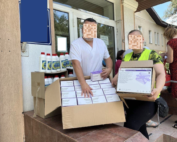
Olha, head of surgery at Zaitsev Hospital, appeared overwhelmed. Her team supports frontline units in addition to full surgical workloads. Her colleague Kyril, also a surgeon, collected us that morning, exhausted after nights spent delivering fuel, water, food and medical supplies to the front. MedAid has been supplying the Zaitsev with tactical medical equipment, destined for the front, for the last three and a half years.
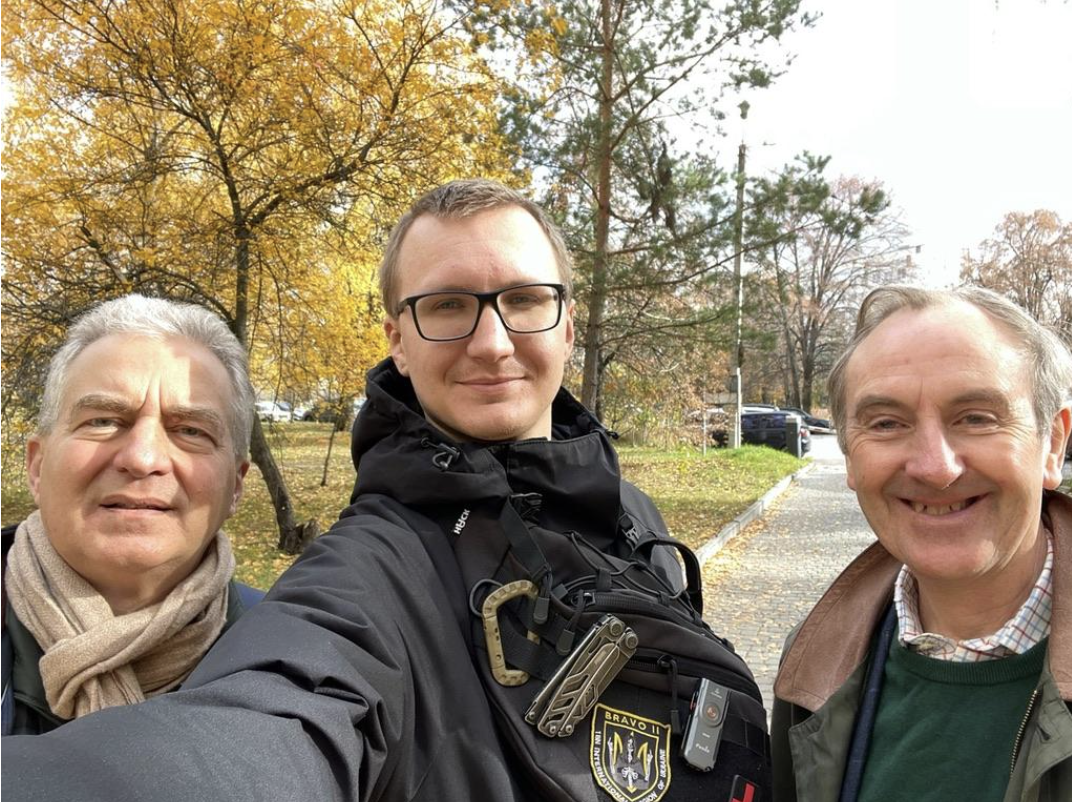
Gavin, Nicholas and surgeon Kyril outside the Zaitsev hospital
“We are desperately short of chest seals, Israeli bandages and tourniquets,” he said. “The fighting is intense at Pokrovsk, Kupiansk and Sumy. We don’t have enough men—and far too few nurses.”
Kyril explained the four-stage evacuation chain, usually by 4WD. Stage one: stabilisation 0–3 km from the front. Stage two: 3–5 km back with additional medics. Stage three: 5–15 km back, the first doctor-led post. Stage four: a hospital like Zaitsev. When we asked why so many posts were needed, he replied simply: “Because the Russians are bombing them.”
Evacuation routes are now shielded by netted tunnels to disrupt drone attacks. “Two out of three vehicles get through,” Kyril said grimly—considered a success. Drones hover, waiting. If one is shot down, another strikes the soldier. Technology shapes both the killing and the attempt to save lives.
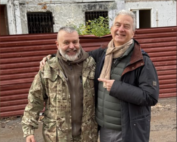
Before leaving Kharkiv we met Father Vitaliy, a frontline chaplain and long-time MedAid partner. Formerly head of DePaul Ukraine in Kharkiv, he sheltered villagers during the 2022 bombardment of Saltivka. Walking through its ruins, he gestured to shattered tower blocks: “Fire and smoke everywhere. Shooting and shooting. For what? These were homes.”
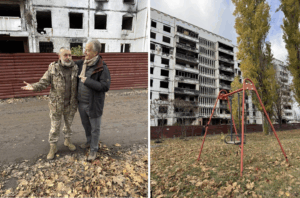
Father Vitaliy and Gavin amidst the ruins of Russian bombed Saltivka
Embedded with his 2000-strong brigade, Vitaliy described life at the front: “If you are in Lviv, you cannot imagine it. At the front, if we fight, we have hope.” He spoke quietly of men loosening tourniquets after days of agony—and bleeding out. “They tell me, ‘Father, pray for us. We don’t know how to pray. We only know how to fight.’”
Kharkiv now houses around one million people, half its pre-war population, alongside many IDPs. Air-raid warnings sound daily. People smile and carry on. The border is only 40 km away.
Share This Post